Best Dehumidifier for Crawl Space: Top Picks for 2026
Maintaining a dry crawl space protects your home’s structure, insulation, and indoor air quality. The right crawl space dehumidifier can remove excess moisture efficiently, prevent mold growth, and operate quietly in tight spaces. Below are five high-performing models that balance capacity, energy efficiency, and practical features like automatic defrost and automatic drainage. Each entry includes an at-a-glance takeaway to help you compare options quickly.
| Product | Key Benefit |
|---|---|
| Airecoler 125 Pints Commercial Dehumidifier | High moisture removal for large spaces, compact fit, energy-efficient |
| Moiswell 70 Pints Commercial Dehumidifier | Energy Star certified with gravity drainage for easy maintenance |
| ALORAIR 113 Pint Dehumidifier | Strong capacity with auto defrost and automatic drainage |
| Waykar 125 Pint Crawl Space Dehumidifier | Large space coverage with pump drainage and versatile installation |
| ALORAIR 70 Pint Wi‑Fi Dehumidifier | Smart control, memory start, ideal for crawl spaces up to 1000 sq ft |
Note: All models listed are designed for crawl spaces, basements, and other tight areas, offering features such as auto defrost, automatic drainage, and robust construction suitable for damp environments.
Airecoler 125 Pints Commercial Dehumidifier

Features: Enhanced Commercial Dehumidification: This unit removes up to 125 pints daily (Max.) and 60 pints AHAM. Suitable for crawl spaces, basements, warehouses, garages, and other large damp areas. Compact design measures 19.2 x 12.2 x 13.4 inches, enabling placement in tight crawlspaces. The R32-based dehumidification system supports energy efficiency, and a 24-hour auto ON/OFF timer helps reduce electricity usage. Memory starting aids in resuming operation after power outages.
Moiswell 70 Pints Commercial Dehumidifier

Features: Energy Star Certified; removes up to 70 pints at saturation and 35 pints per day AHAM. Gravity drainage system allows condensation water to be directed to an external point, reducing maintenance. An intuitive control panel with a large display enables easy monitoring, humidity setting, and a 24-hour timer for automated operation. The unit supports continuous drainage and requires minimal manual intervention.
ALORAIR 113 Pint Dehumidifier

Features: 113 Pint capacity at saturation, 53 pints per day AHAM, auto defrost and automatic drainage to avoid continual water emptying. Durable metal outer casing supports rugged use in crawl spaces, basements, and industrial settings. A MERV-1 filter helps protect internal components from dust during operation. The unit is designed for continuous, maintenance-free drainage and robust performance in challenging environments.
Waykar 125 Pint Crawl Space Dehumidifier

Features: 125 pints per day with 300 CFM airflow; suitable for spaces up to 6,500 sq ft. Includes a 16.4 ft pump drainage hose and a 6.6 ft gravity drainage hose, plus 5.9-inch pipe-mounted exhaust vents. Certified by TUV, offering energy-efficient operation and flexible installation options to accommodate high-position or long-distance drainage needs.
ALORAIR Wi‑Fi Crawl Space Dehumidifier, 70 Pint
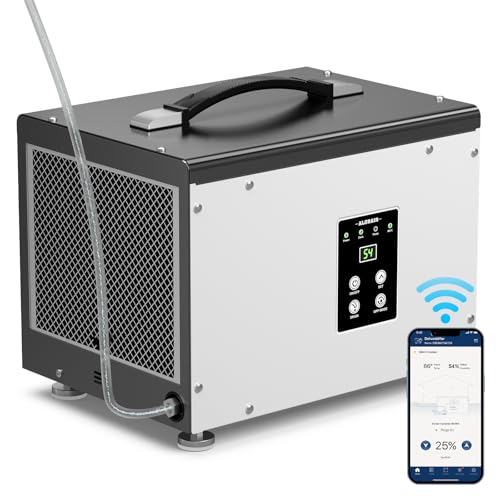
Features: 70-pint capacity with pump drainage and auto defrost; ideal for crawl spaces up to 1,000 sq ft. Wi-Fi remote monitoring via app; memory start and a low-noise profile (under 50 dB). The unit includes continuous drainage with an auto restart after power outages, and a compact, modern design suitable for tight spaces.
Buying Guide: Key Considerations For Choosing A Crawl Space Dehumidifier
- Moisture removal capacity: Match the unit’s pints per day to the size and dampness level of your crawl space. Larger spaces or continuously damp environments need higher capacities (e.g., 125 pints or more).
- Drainage options: Determine whether you prefer gravity drainage, a pump, or both. Pumps offer flexible placement and vertical drainage, while gravity drains are simple and reliable for lower installations.
- Energy efficiency: Look for ENERGY STAR certification or similar efficiency ratings. Energy-efficient units save operating costs over time, especially for continuous use.
- Auto defrost and temperature tolerance: In cooler crawl spaces, auto defrost prevents frost buildup and maintains performance. Low-temperature operation is a practical bonus.
- Automatic restart and memory features: In power outage scenarios, memory start can resume operation without manual intervention, reducing downtime.
- Noise level: For crawl spaces near living spaces, consider models with lower decibel ratings to minimize disturbance.
- Control and monitoring: Remote or app-based controls can improve convenience, especially for spaces not easily accessible. Look for humidity controls that offer a wide range and precise settings.
- Durability and warranty: Metal casings and robust construction are important for harsh environments. Check warranty length for long-term protection.
- Size and installation flexibility: Consider the unit’s footprint and clearance requirements. Narrow or compact designs fit tight crawl spaces, while some units offer ceiling or joist-mounted installation options.
- Maintenance needs: Assess filter maintenance, drainage hose length, and ease of emptying or pumping requirements to minimize ongoing tasks.