Best Treatments for Drywood Termites: Effective on-Contact Solutions and Wood Treatments
Drywood termites can cause notable damage to structures by nesting within wood. This guide highlights proven products designed to kill exposed termites on contact, reach interior voids, and provide long-lasting protection for new and existing buildings. Below are five reliable options commonly used by homeowners and professionals, followed by a practical buying guide to help you choose the right solution for your situation.
| Product | Why It’s Notable |
|---|---|
| Spectracide Terminate Termite Killing Foam (16 fl oz) | Foaming aerosol expands into voids and cracks to kill exposed termites on contact; also targets carpenter bee activity. |
| Spectracide Terminate Termite Killing Foam (Pack of 4) | Same active action with multiple cans for larger areas or multiple applications. |
| Bora-Care Termiticide Insecticide & Fungicide Concentrate (1 Gallon) | Deep-wood penetration for long-term protection against termites, carpenter ants, beetles, and decay fungi. |
| Harris Carpenter Ant Killer & Termite Control (128 oz) | Ready-to-use formula with trigger sprayer for on-contact kill and lasting protection. |
| Bonide Termite & Carpenter Ant Killer (32 oz Concentrate) | Broad-spectrum outdoor/in lawn and home use with long-lasting barrier potential. |
Note: The products listed above are selected for relevance to drywood termite control, including contact-kill foams and wood-treatment concentrates designed to protect structural wood. This article provides an objective overview of each option, its application, and practical considerations for choosing between them.
Spectracide Terminate Foam – 16 Fl Oz
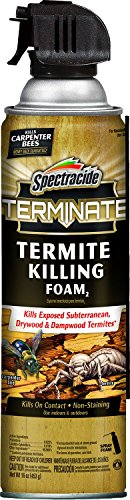
Spectracide Terminate Termite Killing Foam is a foaming aerosol designed to reach hidden termite activity behind veneers, within voids, channels, and cracks. Its rapid-contact formula targets exposed subterranean, drywood, and dampwood termites while also addressing carpenter bee activity in active tunnels. The foam expands to fill irregular spaces, which helps treat areas that are difficult to access with traditional liquids or dusts. For best results, apply directly to identifiable termite galleries and voids, and reapply as needed according to label directions. This product is suitable for users seeking quick on-site knockdown and localized control without drilling or trenching.
Key considerations:
– Pros: On-contact kill, expands to reach hidden spaces, effective against multiple termite types and carpenter bee activity.
– Cons: Requires careful application to avoid unintended exposure; effectiveness depends on reach into voids.
– Best used: In interior voids, behind damaged wood, and in cracks where termites travel.
Spectracide Terminate Foam (Pack of 4)
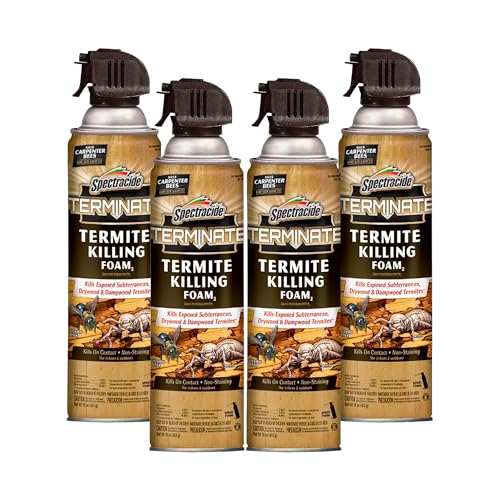
This product line mirrors the single-can foam formula but provides a pack of four cans for larger projects or ongoing termite management. The foaming action continues to expand into inaccessible areas, increasing coverage in ceilings, walls, and hidden voids where termites establish colonies. It shares the same on-contact termite kill and carpenter bee activity coverage as the single can, making it a practical option for bigger homes or properties with extensive termite activity.
Key considerations:
– Pros: Greater quantity for multiple rooms, consistent performance with the same formulation.
– Cons: Handling and storage of multiple cans; ensure even distribution in voids.
– Best used: Sequential or staged treatments in larger structures or multi-story homes.
Bora-Care Termiticide Insecticide & Fungicide Concentrate (1 Gallon)

Bora-Care is a wood-treatment concentrate designed for long-term protection by penetrating deep into wood fibers. It targets termites, carpenter ants, wood-boring beetles, and decay fungi, providing a protective barrier that lasts for the life of the wood when applied as part of a comprehensive maintenance plan. The product is applied with a two-foot band treatment and is suitable for both new construction and existing structures, reducing wood-to-soil exposure concerns and improving overall defense against drywood and subterranean termites. It integrates easily with other prevention strategies like barrier treatments or structural inspections.
Key considerations:
– Pros: Deep-wood penetration, long-lasting protection, suitable for new and existing structures.
– Cons: Requires mixing and precise application; not a stand-alone liquid barrier against soil termites without broader plan.
– Best used: As part of a whole-house wood-treatment approach or during framing/dry-in phases for new builds.
Bora-Care Termiticide 1 Gallon (2 Pack)

This listing features Bora-Care’s two-pack provision in one option, offering another practical way to secure whole-house protection. Like the single-gallon option, it emphasizes deep wood penetration and long-term termite, carpenter ant, beetle, and decay fungus prevention. The approach emphasizes a two-foot wood treatment band for efficient coverage during drying-in or in existing structures, supporting a sustained defense against drywood and subterranean termites when paired with a compatible prevention plan.
Key considerations:
– Pros: Cost-effective for multiple applications; consistent deep-wood protection.
– Cons: Similar preparation and application steps as the single-gallon variant; ensure proper dilution per label.
– Best used: In new construction projects or major remodels requiring extended termite prevention.
Harris Carpenter Ant Killer & Termite Control

Harris Carpenter Ant Killer & Termite Control is a ready-to-use formulation featuring a trigger sprayer for precise application. It kills carpenter ants, termites, and other common household ants on contact and provides ongoing protection for up to a month after the initial application. This product is particularly convenient for spot treatments and quick knockdown in problem areas like baseboards, around window frames, and behind outlets where termite activity might be observed. Its odorless, non-staining formula helps minimize disruption during use.
Key considerations:
– Pros: Easy-to-use trigger spray; on-contact action with short-term residual protection.
– Cons: Shorter protection window compared with more durable wood-tinish treatments; may need repeated applications.
– Best used: Quick response zones and high-traffic indoor areas where termites or carpenter ants are seen.
Bonide Termite & Carpenter Ant Killer (32 oz Concentrate)
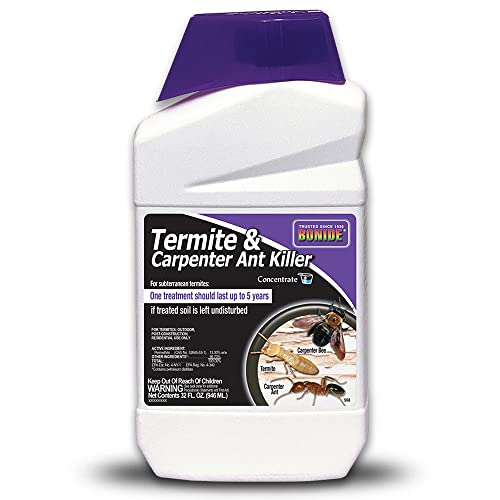
Bonide Termite & Carpenter Ant Killer is a broad-spectrum concentrate suitable for outdoor lawn and home applications. It supports long-lasting protection by creating a barrier approach when used in soil trenches or perimeter treatments, targeting subterranean termites and carpenter ants, among other pests. This option is well-suited for homeowners seeking a systemic deterrent across exterior structures and adjacent landscape areas, contributing to a comprehensive pest control strategy that includes termite management and general insect deterrence.
Key considerations:
– Pros: Broad-spectrum effect; outdoor and lawn application scope; potential long-term barrier.
– Cons: Requires mixing and proper soil integration if used as a barrier treatment.
– Best used: Exterior perimeter treatments and lawn-adjacent areas to reduce termite ingress.
Buying Guide: Key Purchase Considerations For Drywood Termite Control
- Termite type and location: Drywood termites are found within wood. Foams and deep-penetrating wood treatments work well for interior voids and structural timbers, while exterior barrier treatments help deter infestations from the outside.
- Application method: Foams are useful for voids and hidden channels; liquid concentrates often require dilution and direct wood application or soil treatment, depending on the product.
- Depth of penetration: Look for products designed to penetrate wood fibers or reach inaccessible cavities. Deep-penetrating products offer longer-lasting protection but may require specialized application techniques.
- Coverage area and frequency: Packaged foams are suitable for localized problems, while concentrates designed for whole-structure treatment support ongoing protection. Consider your home size and the extent of termite activity.
- Safety and odor: Opt for formulations labeled as odorless or low-odor for indoor use, especially in living spaces. Always follow label directions for safe handling and ventilation.
- Professional vs. DIY approach: Some products are DIY-friendly with straightforward spray or dilution methods; others are better suited for professional application, particularly where structural integrity or large-scale infestations are involved.
- Combination strategies: For best results, combine termite-killing foams for localized exposure with wood-treatment concentrates for long-term protection, along with routine inspections and moisture control to reduce termite attractants.
- Regulatory and label compliance: Always check the product label for specific termite species coverage, application windows, and any restrictions on use around pets and children.
When selecting a product, consider the specific conditions of your property, including wood types, moisture levels, and the presence of active galleries. For best outcomes, align the product choice with a broader termite management plan that includes periodic inspections, moisture control, and, if necessary, professional consultation for structural assessment and treatment.