Best Ro System for Drinking Water: Top Pick Reverse Osmosis Systems for Pure, Great-Tasting Water
Accessing clean, great-tasting drinking water at home starts with a reliable reverse osmosis (RO) system. This guide highlights five top RO systems that balance filtration power, mineral remineralization, and ease of installation for American households. Each pick offers strong contaminant removal, from chlorine and lead to PFAS, while preserving or restoring essential minerals for healthier-tasting water. Below, you’ll find a quick product snapshot and detailed sections to help you compare features, installation needs, and long-term maintenance.
Summary at a glance: The chosen systems emphasize strong impurity removal, durability, and user-friendly designs. They include top-mmounted faucet setups for simple installs, remineralization options for balanced pH, and tankless or standard configurations to fit different under-sink spaces. See the table for quick reference on capacity, stages, and standout features.
| Product | Brand | Stages | GPD | Notable Feature |
|---|---|---|---|---|
| iSpring RCC7AK | iSpring | 6 | 75 | AK remineralization stage |
| APEC Water Systems ROES-50 Essence | APEC | 5 | 50 | Ultra-safe filtration |
| APEC Water ROES-PH75X | APEC | 6 | 75 | PH+ remineralization |
| iSpring RCC7 | iSpring | 5 | 75 | Top-mounted faucet design |
| Waterdrop WD-T4-A | Waterdrop | 10 | 450 | Dual water options, 2:1 purge |
iSpring RCC7AK, 6-Stage Alkaline RO System

The iSpring RCC7AK 6-stage RO system combines solid contaminant removal with mineral restoration. It delivers up to 75 gallons per day and includes a patent-pending alkaline remineralization stage (AK) to improve water taste and pH. The top-mounted faucet design enables easy installation from above the sink, avoiding tricky nut-tightening under the cabinet. A transparent first-stage housing lets users monitor filter life at a glance, simplifying maintenance and timely replacements.
Key features include NSF/ANSI certifications for water safety, a remineralization stage to reintroduce essential minerals, and a compact footprint suitable for many kitchen configurations. The system maintains performance with minimal energy use and provides a reliable supply of purified water for drinking and cooking. Regular filter changes keep performance consistent and reduce the risk of bypassing filtration.
APEC Water Systems ROES-50 Essence Series

This five-stage system emphasizes reliability and safety, designed to remove a broad spectrum of impurities including chlorine, lead, fluoride, arsenic, and many other contaminants. The ROES-50 Essence is WQA certified and built to handle both city and well water with durable, premium components. With a maximum TDS handling capacity of around 2000 ppm, it maintains robust filtration performance across a wide range of feed water conditions. It’s a solid choice for households seeking clear, crisper-tasting water with consistent filtration outcomes.
Owners benefit from easy filter changes and a compact under-sink footprint. The system is engineered for long-term use, aiming to deliver reliable drinking water without frequent upkeep. While some setups may require more initial configuration, the overall maintenance and filtration performance make it a strong, dependable option for daily use.
APEC Water ROES-PH75X 6-Stage Alkaline RO System

This 75 GPD, 6-stage RO system adds a remineralization stage to deliver a natural spring-like taste. It removes up to 99% of common impurities including fluoride, arsenic, lead, and heavy metals, with a maximum TDS handling of 2000 ppm. Calcareous minerals are reintroduced to create a balanced pH and improve water mouthfeel. The design emphasizes premium, durable filters and components to support long-term reliability and quiet operation.
Suitable for households seeking enhanced mineral content and a consistent, crisp taste, the ROES-PH75X emphasizes performance consistency and user-friendly maintenance. As with other RO systems, regular filter changes are essential to sustain filtration efficiency and water quality.
iSpring RCC7: Five-Stage Under-Sink RO System

The iSpring RCC7 is a popular 5-stage RO system that delivers up to 75 GPD. It removes a wide range of contaminants, including PFAS, chlorine, fluoride, lead, arsenic, and asbestos, with a notable reduction in total dissolved solids. The system is NSF/ANSI 58 & 372 certified, ensuring industry-standard safety and performance. Its design emphasizes a leak-free operation with a transparent first-stage housing for quick inspections, making maintenance straightforward. The unit fits under many kitchen sinks and typically requires no power source, relying on direct water pressure to operate.
Notable advantages include the proven track record, compact installation footprint, and easy monitoring of filter life. The top-mounted faucet design adds to installation simplicity. Regular maintenance helps sustain water quality and extends the life of the system’s filters and membrane.
Waterdrop WD-T4-A Alkaline 10-Stage RO System
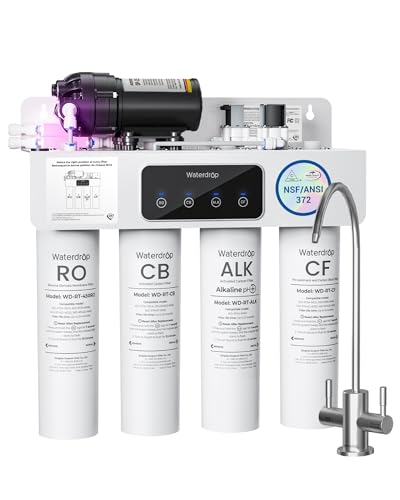
The WD-T4-A is a high-capacity, tankless RO system with 10 filtration stages and dual water output. It offers a standard purified stream plus a mineral-enhanced alkaline stream, enabling a choice based on preference. The system supports a 450 GPD flow rate and uses a 2:1 pure-to-drain ratio to conserve water. An integrated mineral-enriched line boosts alkalinity for improved taste, while dual LED indicators help verify filtration status and water safety from filtration to faucet. It requires an electrical connection for operation.
With advanced filtration and a two-way water option, the WD-T4-A is well-suited for households that want both exceptionally clean water and a controllable mineral boost. The trade-offs include higher installation complexity and the need for access to an electrical outlet under the sink for proper operation.
Waterdrop G3P600—Tankless 8-Stage RO System

The Waterdrop G3P600 is an eight-stage, tankless RO system designed for compact under-sink installation with high efficiency. It combines NSF/ANSI 58 and 372 certifications for lead-free materials and TDS reduction, plus NSF/ANSI 42 for chlorine removal and taste/odor improvement. A smart display faucet provides real-time feedback on water quality and filter life. The system is engineered to reduce wastewater and deliver consistent purified water with a user-friendly interface and long-term reliability. It is suitable for homes seeking advanced monitoring and minimal maintenance, though it requires electrical connection for operation.
Overall, the G3P600 offers a modern, feature-rich solution with strong performance metrics, a tankless design to save space, and a smart faucet for intuitive operation. Regular filter changes and membrane maintenance remain essential to sustain water quality and system efficiency.
Buying Guide: Key Purchase Considerations And Comparisons
- Filtration stages and contaminant targets: More stages can support stricter impurity removal and remineralization, but may increase maintenance needs. Consider whether you want chlorine, fluoride, heavy metals, PFAS, or mineral remineralization.
- Remineralization and pH balance: Systems like AK and PH+ remineralize water to balance pH and improve taste. If you prefer a “natural spring” taste, look for a remineralization stage with calcium and magnesium.
- GPD and daily needs: Higher GPD (gallons per day) is beneficial for larger families or higher water usage. Tankless systems provide continuous flow but require electrical supply for operation.
- Installation and space: Top-mount faucet designs simplify installation. Tankless setups save under-sink space but may require more wiring and plumbing considerations.
- Maintenance and filter life: NSF/ANSI certifications indicate standards compliance. Check filter replacement frequency and the availability of replacement parts in your region.
- Water source compatibility: Some systems are better suited to well water or hard water; others handle municipal supply well. Check feed water pressure requirements (usually 40–85 psi).
- Water waste considerations: Some modern RO systems reduce wastewater with 2:1 or better ratios; others may require a balancing approach depending on your water pressure and household usage.
- Electrical requirements: Tankless and dual-output models may need an electrical outlet under the sink or a nearby available connection. Ensure your setup complies with local codes.
- Certifications and safety: Look for NSF/ANSI 58 and 372 certifications for safety and lead-free materials. WQA certification is another strong indicator of system reliability.