Best 75 Gallon Gas Water Heaters for Home Comfort and Efficiency
Finding the right 75 gallon gas water heater involves balancing capacity, energy efficiency, warranty, and installation needs. This guide highlights top options that align with the 75-gallon benchmark, focusing on models designed for reliable hot water delivery in larger homes or households with high simultaneous usage. You’ll find storage tank options that hold a full supply of hot water, plus tankless or hybrid variants that pair well with larger homes when space and energy use matter. Use the buying guide to compare key features and select the best fit for your household.
| Product | Brand | Type | Capacity / Output | Key Benefit |
|---|---|---|---|---|
| Reliance 6 75 XRRS | Reliance | Storage Tank | 75 Gallon | Strong warranty; natural gas |
| Rheem RTGH Series 8.4 GPM | Rheem | Tankless | 0.4 – 8.4 GPM | High flow, compact footprint |
| Rheem RTG-70XLN-3 | Rheem | Tankless Outdoor | 7.0 GPM | Outdoor installation; efficiency |
| Orbek 100,000 BTU Tankless | Orbek | Tankless | Up to 4.3 GPM | CSA certified safety features |
| Rinnai V75IN | Rinnai | Tankless | 7.5 GPM | Endless hot water; compact |
Reliance 6 75 XRRS 75 Gallon Gas Water Heater

The Reliance 75 gallon natural gas storage water heater provides a robust 75,100 BTU/hr input and a six-year warranty, making it a common choice for households needing ample hot water. Designed for standard residential installations, this model emphasizes reliability in colder climates or larger homes with higher daily hot water usage. Its storage design ensures a ready supply of hot water, even during peak demand periods, while natural gas operation helps control ongoing energy costs compared to electric equivalents.
Rheem RTGH8.4 GPM Tankless Gas Water Heater

The Rheem RTGH tankless unit offers a broad flow range (0.4–8.4 GPM) with temperature settings from 100 to 140°F and a default flow of 120°F. This model provides on-demand hot water without storage, which can be advantageous for homes prioritizing space efficiency and reduced standby energy losses. An electric ignition simplifies startup, and precise temperature control helps prevent sudden swings in hot water temperature during multiple simultaneous uses.
Rheem RTG-70XLN-3 High Efficiency Tankless Outdoor

This outdoor, non-condensing tankless model from Rheem delivers 7.0 GPM with high-efficiency operation. It’s designed for outdoor installation and can support multiple simultaneous hot water draws, such as showers and dishwashing. Energy savings come from the unit only firing when hot water is requested, reducing standby losses and offering a compact solution where indoor space is limited.
Orbek Natural Gas Tankless 100,000 BTU

The Orbek tankless heater provides up to 4.3 GPM at 100,000 BTU, with CSA certification and safety features such as dry combustion protection and high water pressure safeguards. It supports 2–3 fixtures simultaneously and offers several heating modes to balance energy use and performance across seasons.
Rinnai V75IN Tankless Hot Water Heater
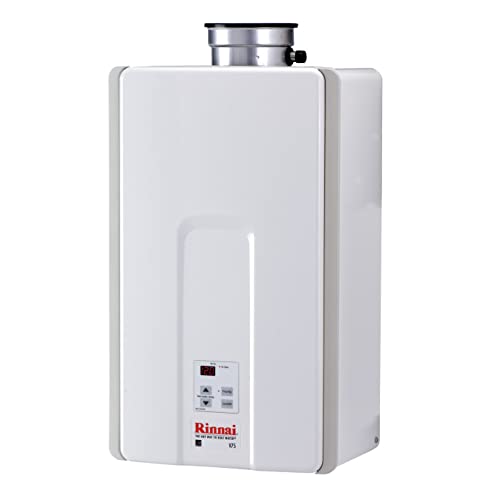
The Rinnai V75IN delivers up to 7.5 GPM of continuous hot water and is designed for indoor installation. Its compact footprint and high efficiency make it suitable for homes that require reliable hot water while reducing space usage. Enhanced scale detection helps minimize long-term damage, ensuring steady performance across multiple appliances at once.
2025 GEN II Ranein Natural Gas Tankless
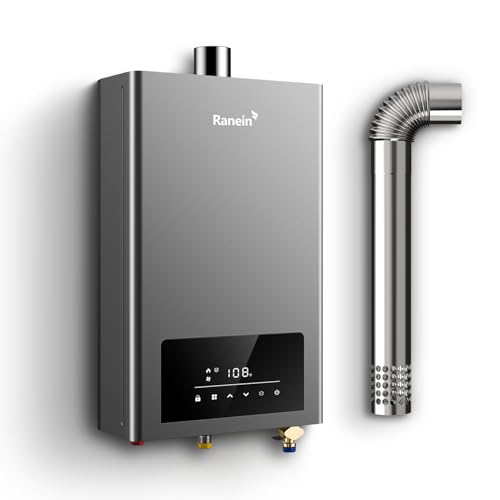
The Ranein GEN II tankless unit offers up to 3.6 GPM with an 80,000 BTU input, suitable for two to three taps. It emphasizes steady temperature control, energy efficiency through on-demand heating, and a modern LED temperature control panel for precise adjustments. It is a practical option for households seeking compact on-demand hot water without a storage tank.
Buying Guide: Key Considerations For Selecting A 75 Gallon Gas Water Heater
- Capacity needs: For households that regularly use hot water simultaneously in showers, laundry, and dishwashing, a 75 gallon storage model can reduce run-out events. Tankless options provide on-demand hot water but require careful sizing to meet peak loads.
- Fuel type and efficiency: Natural gas units typically offer rapid recovery and lower operating costs. Compare energy factors (EF) or uniform energy factors (UEF) to gauge long-term efficiency and potential savings.
- Storage vs. tankless trade-offs: Storage tanks deliver a ready supply but can experience standby losses. Tankless systems save energy by heating on demand but may require higher upfront costs and more complex installation to meet simultaneous demand.
- Ventilation and installation: Gas water heaters require proper ventilation and clearances. Indoor installations should consider space, vent size, and clearance around the unit, while outdoor models avoid indoor ventilation needs but need weather considerations.
- Warranty and service: A strong warranty protects against early failures. Look for units with 6–12 year warranties on tanks and longer coverage for parts. Local service availability matters for timely maintenance.
- Safety features: Look for overheat protection, flame failure protection, dry combustion protection, and leak safeguards, especially for tankless models that operate in various conditions and elevations.
- Flow and temperature control: Tankless models should provide precise temperature control with minimal fluctuations when multiple fixtures demand hot water. For storage tanks, consider recovery rate to refill hot water after significant usage.
- Maintenance needs: Sediment build-up can affect storage tanks; consider pre-scouring and periodic flushing. Tankless units may require descaling in hard-water regions to prevent mineral buildup.
Choosing between 75 gallon storage and modern tankless gas heaters depends on home size, peak usage, and installation constraints. The models listed provide a range of options—from large-capacity storage to compact on-demand systems—so homeowners can select based on reliability, space, and energy considerations.